Water Softener Sizing Calculator
An undersized softener regenerates constantly and wastes salt; an oversized one wastes money and can channel. Enter your household size and water hardness to find the right grain capacity.
Your Water & Household
Your water report lists hardness in grains per gallon (gpg) or ppm/mg/L. Don't know it? Typical US municipal water is 7–10 gpg; well water is often 15–25+ gpg.
Sizing Recommendation
Recommended system size
24,000 grain
Sized to regenerate about once a week at your water and household.
10.0
Effective hardness (gpg)
3,000
Grains removed per day
21,000
Weekly capacity needed
How we calculated this: 4 people × 75 gallons/day × 10.0 gpg = 3,000 grains of hardness to remove per day. Multiplied by a 7-day regeneration target, you need a softener rated for at least 21,000 grains. Sizing up to the next standard rating (24,000 grain) lets the unit regenerate less often and use salt more efficiently.
Softeners That Fit Your Home
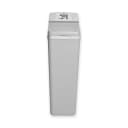
Whirlpool WHES30E (30,000 grain)
30,000 grain · Digital, demand-initiated regeneration
1–4 people, moderate hardness
At your water, regenerates roughly every 8 days
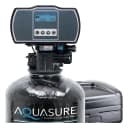
Aquasure Harmony Series (32,000 grain)
32,000 grain · Automatic digital metered control head
1–4 people, 1–2 bathrooms
At your water, regenerates roughly every 8 days
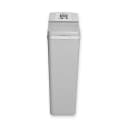
Whirlpool WHES40E (40,000 grain)
40,000 grain · Digital, demand-initiated regeneration
4–6 people, hard water with some iron
At your water, regenerates roughly every 10 days
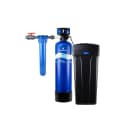
Aquasana SimplySoft (40,000 grain)
40,000 grain · Metered demand regeneration, LCD controller
Up to 5 people / 4 bathrooms, moderate to hard water; sold direct with 10-year tank warranty
At your water, regenerates roughly every 10 days
What Size Water Softener Do You Need? The Formula
Water softeners are sized by grain capacity — how much hardness they remove between regenerations. The goal is a unit that regenerates about once a week, which keeps the resin healthy and salt use efficient. The math is straightforward:
grains per day × 7 days = grain capacity you need
If your water also contains clear-water iron, add about 4 gpg of hardness for every 1 ppm of iron before calculating — iron consumes softening capacity too. Then round up to the next standard size: 24,000, 32,000, 40,000, 48,000, 64,000, or 80,000 grain.
Recommended Size by Household & Hardness
Quick reference for typical homes (no significant iron). These are the same numbers the calculator produces — find your row and column, then size up if you have iron or expect household growth.
| Household | Moderate (~10 gpg) | Hard (~20 gpg) | Very hard (~30 gpg) |
|---|---|---|---|
| 1–2 people | 24,000 grain | 24,000 grain | 32,000 grain |
| 3–4 people | 24,000–32,000 grain | 48,000 grain | 64,000 grain |
| 5–6 people | 32,000 grain | 64,000 grain | 80,000 grain / twin-tank |
Assumes ~75 gallons/person/day and a weekly regeneration target. Heavy water use, iron, or a large home pushes you to the next size up.
Water Hardness Scale
Hardness is measured in grains per gallon (gpg) or milligrams per liter (mg/L, the same as ppm). One grain per gallon equals 17.1 mg/L. The USGS classifies hardness as:
| Classification | mg/L (ppm) | Grains per gallon |
|---|---|---|
| Soft | 0–60 | 0–3.5 |
| Moderately hard | 61–120 | 3.6–7.0 |
| Hard | 121–180 | 7.1–10.5 |
| Very hard | Over 180 | Over 10.5 |
Salt-Based vs Salt-Free: Why This Calculator Only Sizes Salt-Based
Only salt-based ion-exchangesofteners actually remove hardness, so they're the only type that can be grain-sized. A salt-based softener swaps calcium and magnesium for sodium on a resin bed, then flushes the resin with salt brine when it's exhausted — that flush is the "regeneration" this calculator sizes for.
"Salt-free softeners" are really water conditioners. They use template-assisted crystallization to keep minerals from sticking as scale, but they don't remove hardness — your water's grain count is unchanged and it won't feel soft. They have no grain capacity and can't be sized this way. If you want genuinely soft water, choose salt-based; if your priority is maintenance-free scale control (or salt discharge is restricted where you live), a conditioner is a different tool for a different job.
Frequently Asked Questions
What size water softener do I need for a family of 4?
It depends on your water hardness. For a typical family of four on city water around 10 grains per gallon (gpg), a 24,000–32,000 grain softener is enough. On hard well water at 20 gpg, step up to about 48,000 grain; at 30 gpg, about 64,000. The rule is to size the unit so it regenerates roughly once a week: people × 75 gallons/day × hardness in gpg × 7 days = the grain capacity you need.
How do I calculate what size water softener to buy?
Multiply the number of people in your home by 75 gallons per day (a standard per-person estimate), then by your water hardness in grains per gallon. That's your daily hardness removal. Multiply by 7 to get the capacity needed to regenerate about weekly, then round up to the next standard size (24,000 / 32,000 / 40,000 / 48,000 / 64,000 / 80,000 grain). If your water has clear-water iron, add roughly 4 gpg of hardness for every 1 ppm of iron before you calculate.
What is grain capacity in a water softener?
Grain capacity is how many grains of hardness a softener can remove before it has to regenerate (flush its resin bed with salt brine). A 40,000-grain unit removes 40,000 grains of hardness per cycle at its maximum salt dose. Because running at the maximum dose is inefficient, softeners are typically operated at about 75% of rated capacity — so a 40,000-grain unit does roughly 30,000 grains of useful work between regenerations.
Is a bigger water softener better?
Up to a point. A softener somewhat larger than your weekly demand regenerates less often and uses salt more efficiently, which saves money over time. But a hugely oversized unit costs more upfront, and if it regenerates too rarely the resin bed can channel and lose efficiency. Aim for a unit that regenerates roughly every 5–10 days — not one massively larger than you need.
How do I find my water hardness?
Check your utility's annual water quality report (Consumer Confidence Report), use an inexpensive hardness test strip, or send a sample to a lab. City reports list hardness in mg/L (ppm) or gpg — divide ppm by 17.1 to convert to gpg. Well water isn't reported by a utility, so test it directly; private wells are also more likely to carry iron, which adds to the softening load.
Do salt-free water softeners work?
Salt-free systems are water conditioners, not true softeners. They use template-assisted crystallization to change how hardness minerals behave (reducing scale buildup) but they do not remove hardness — the grain count of your water is unchanged, and it won't feel 'soft.' If your goal is genuinely soft water (no spotting, softer-feeling skin, less soap), you need a salt-based ion-exchange softener, which is what this calculator sizes. Salt-free conditioners can be a reasonable scale-control option where salt discharge is restricted or maintenance-free operation matters most.
How much salt does a water softener use?
Roughly 30–80 lbs of salt per month for a typical household, depending on hardness, water use, and how efficiently the unit is sized and programmed. A right-sized softener with demand-initiated (metered) regeneration uses far less salt than an oversized or simple timer-based unit, because it only regenerates when it has actually exhausted its capacity.
Sources
- USGS — Hardness of Water — hardness classification and gpg/mg-L conversion
- Water Quality Association — softener sizing methodology and ion-exchange basics
- EPA — Secondary Drinking Water Standards — hardness and iron as nuisance (aesthetic) parameters
Related Tools & Resources
Sizing estimates based on standard per-person water use and a weekly regeneration target — test your water and consult a licensed installer for precise sizing.