Waterdrop G3P600 Review: The Tankless RO for Most Homes?
Review
Verdict:the G3P600 is the tankless reverse osmosis system we recommend to most households on municipal water. It delivers 600 gallons a day on demand, wastes half a gallon per gallon filtered, fits in a small cabinet, and is certified by IAPMO R&T to NSF/ANSI 42, 53, 58 and 372. Two things keep it from being a no-brainer: the certified claims Waterdrop itemizes are narrower than the long list of contaminants in its marketing, and its proprietary cartridges cost about twice what a tank RO’s do. At $539 direct (often $399-$429 on promotion) it is still the best balance of convenience, certification and price in the tankless category.
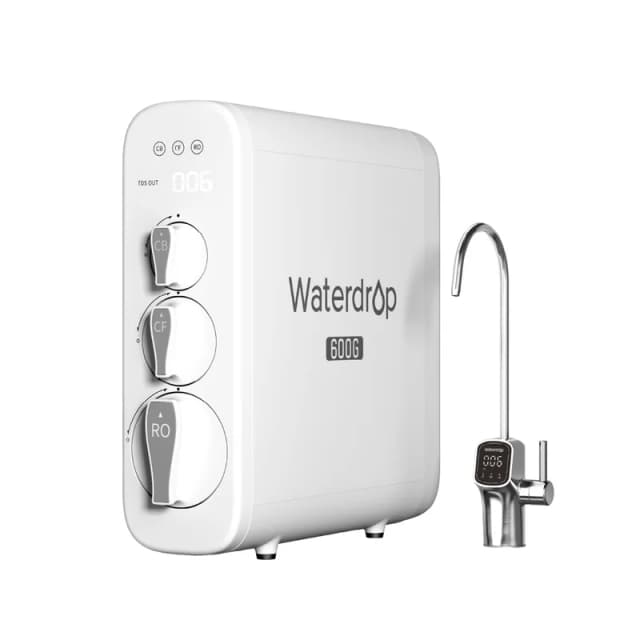
Best tankless RO for most homes
Waterdrop G3P600
Best tankless RO for most homes
Waterdrop G3P600
Under-sink reverse osmosis
Same platform and cartridges as Waterdrop's flagship G3P800, minus the UV stage and 200 GPD, for roughly half the money. IAPMO R&T certified to NSF/ANSI 42, 53, 58 and 372, with TDS and chlorine as the headline certified claims.
$539
price checked Sep 2026 · ~$155/yr filters
What we like
- ✓600 GPD on demand - about 8 seconds per cup, no tank to refill
- ✓2:1 pure-to-drain ratio; roughly a third of the wastewater of a 1:3 tank system
- ✓IAPMO R&T certified to NSF/ANSI 42, 53, 58 and 372
- ✓Smart faucet shows live TDS and filter life; auto-flush protects the membrane
- ✓Compact: stands on end in a cabinet the size of a shoebox
- ✓1-year warranty; frequent promotions take it from $539 to $399-$429
What to know before buying
- ✗Certified claims itemized by Waterdrop are TDS and chlorine; lead, fluoride, arsenic and PFAS figures are not itemized as certified
- ✗Proprietary cartridges run ~$155/yr - about double iSpring or APEC
- ✗Needs an outlet under the sink; pump is audible (~46 dB at 1 ft)
- ✗No remineralization unless you add the optional MNR35 filter
- ✗Faucet needs a 1 in. hole; some sinks need drilling
Who should buy the G3P600
A good fit if you...
- ✓Are on municipal water and want RO-level TDS, taste and general contaminant reduction
- ✓Cook a lot or have a household of 3+ and are tired of a tank running empty
- ✓Have limited cabinet space or want to keep the disposal and bins
- ✓Care about wastewater (2:1 vs a typical 1:3 tank RO)
Look elsewhere if you...
- ✗Need certified lead, arsenic or fluoride reduction - see the G3P800, iSpring RCC7AK or Aquasana SmartFlow
- ✗Want the lowest cost of ownership - a tank RO saves ~$75/yr on filters
- ✗Have no outlet under the sink and cannot add one
- ✗Are on a private well with bacteria - RO is not a disinfection step; add UV
What the certification actually covers
This is the part most reviews skip. Waterdrop’s product page states: “System Certified by IAPMO R&T to NSF/ANSI 42, 53 and 58 for the reduction of the claims specified on the Performance Data Sheet, and to NSF/ANSI 372 for low lead.” The operative phrase is “the claims specified on the Performance Data Sheet”: a certification covers the contaminants on that sheet, not the full list in the marketing. Waterdrop’s own FAQ on the same page summarizes the G3P600 as “certified against NSF/ANSI 58 for TDS reduction and NSF/ANSI 372”, and on the G3P800 it explicitly marks lead, VOCs and heavy metals as third-party tested rather than certified.
| Standard | Covers | Status |
|---|---|---|
| NSF/ANSI 42 | Aesthetic effects: chlorine, taste, odor, particulates | Certified (IAPMO R&T) |
| NSF/ANSI 53 | Health effects: lead, cysts, VOCs, PFOA/PFOS and others | Certified (IAPMO R&T) |
| NSF/ANSI 58 | Reverse osmosis systems: TDS plus listed contaminants | Certified (IAPMO R&T) |
| NSF/ANSI 372 | Lead-free plumbing materials (no reduction claims) | Certified (IAPMO R&T) |
Per Waterdrop's product page: system certified by IAPMO R&T to NSF/ANSI 42, 53 and 58 for the reduction claims on its Performance Data Sheet, and to NSF/ANSI 372 for low lead. TDS (58) and chlorine (42) are the headline certified claims; Waterdrop does not itemize the G3P600's NSF 53 claims on the page, and on the sibling G3P800 lead is a third-party-tested claim rather than a certified one, so lead, fluoride, arsenic, chromium-6 and PFAS are recorded as claims here until the data sheet is checked.
Certified reductions
- TDS - 94%
- Chlorine
Manufacturer / lab-tested claims
- Lead
- Fluoride
- Arsenic
- Chromium 6
- PFAS
Independent lab testing by reviewers generally backs the marketing - Water Filter Guru measured 100% lead, chlorine and arsenic reduction and 95% TDS on the G3 platform - but a lab test is a snapshot, and a certification is audited. We show both so you can decide how much that matters for your water. If your local report shows arsenic or fluoride, prefer a system whose listing names it.
Specifications
| Type | Under-sink reverse osmosis |
|---|---|
| Rated capacity | 600 gallons per day |
| Flow rate | 0.42 GPM |
| Drain ratio | 2:1 pure-to-drain |
| Storage tank | None (tankless, on demand) |
| Dimensions | 18.1 x 5.7 x 17.8 in (459 x 144 x 451 mm) |
| Weight | 28.7 lb (13 kg) |
| Installation | Moderate DIY (basic plumbing) |
| List price | $539 |
| Annual replacement cost | ~$155/yr |
Tankless, 600 GPD, 2:1 pure-to-drain, ~8 seconds per cup, smart faucet with TDS and filter-life readout. No UV stage (that is the G3P800). Needs an under-sink outlet.
Installation and living with it
Installation is standard under-sink RO work: a feed adapter on the cold line, a drain saddle, and the dedicated faucet. The one wrinkle is the faucet base, which wants a 1-inch hole; if your sink has a smaller sprayer knockout you will need to drill it out. Budget 60-90 minutes. Because the system is tankless it needs the included power adapter plugged in under the sink.
Day to day, the faucet’s LED ring shows TDS and filter status, and the unit flushes its membrane automatically. Flow is the big lifestyle change from a tank system - a quart in about 30 seconds - so filling pots and pitchers stops being a wait. The pump is audible while dispensing; measured levels around 46 dB at one foot are similar to a quiet fridge, and it is silent at rest.
The known weak points in owner reviews are seal leaks on a small number of units (Waterdrop’s 1-year warranty and 30-day return with a 10% restocking fee apply) and drain ratios that drift above 2:1 when inlet pressure is low. Neither is unique to Waterdrop; both are worth knowing.
Replacement filters and real ownership cost
Tankless convenience is paid for in cartridges. The G3P600 uses three proprietary filters; the table shows list prices and how they work out per year.
| Part | Change every | Price | Per year |
|---|---|---|---|
| CF Sediment/Carbon Pre-Filter (WD-G3-N1CF) | 6 months | $30 | $60 |
| CB Carbon Block Filter (WD-G3-N3CB) | 12 months | $40 | $40 |
| RO Membrane (WD-G3P600-RO) | 24 months | $109.99 | $55.00 |
| Estimated annual cost | $155 | ||
Prices are list prices from the data layer and change often; brand subscription programs (Aquasana Water for Life, Waterdrop subscribe-and-save) typically cut 10-15%. Track your own schedule with the Replacement Tracker. Shop replacement filters.
For context, here is how it stacks up against the two other Waterdrop tankless systems and the two best-selling tank systems, using the same data layer that powers our tools.
| WaterdropG3P600 | WaterdropG3P800 | WaterdropD6 | iSpringRCC7AK | APECROES-50 | |
|---|---|---|---|---|---|
| Price | $539 | $999 | $399 | $198 | $199.95 |
| Certifications | NSF42NSF53NSF58NSF372 | NSF42NSF53NSF58NSF372 | No NSF/ANSI certification | NSF58 | NSF58 |
| Capacity | 600 GPD | 800 GPD | 600 GPD | 75 GPD | 50 GPD |
| Drain ratio | 2:1 pure-to-drain | 3:1 pure-to-drain | 1:1 pure-to-drain | 1:3 pure-to-drain | 1:3 pure-to-drain |
| Tank | Tankless | Tankless | Tankless | 3.2 gal | 4 gal |
| Filters / yr | $155 | $166 | $100 | $81 | $75 |
| Buy at Waterdrop → | Buy at Waterdrop → | Buy at Waterdrop → | Buy on Amazon → | Buy on Amazon → |
G3P600 vs G3P800: which one?
The G3P800 is the same machine with three upgrades: a UV LED stage in the faucet path, 800 GPD instead of 600, and 3:1 instead of 2:1 pure-to-drain. Waterdrop also itemizes its certified reductions - fluoride, PFOA/PFOS, TDS, chromium and chlorine under IAPMO NSF/ANSI 42, 53 and 58 - which is the most concrete reason to pay the difference ($999 vs $539 at the time of checking). Filter costs are nearly identical because the CF and CB cartridges are shared; only the membrane differs.
Our take:buy the G3P600 unless your water report shows fluoride, PFAS or chromium-6 and you want a certified claim for them, or you specifically want the UV stage. Watch for the G3P800’s frequent sales - it has dropped to $699-$849 during Waterdrop and Amazon events, at which point the gap narrows enough to justify it.
Alternatives worth a look
- Aquasana SmartFlow RO - tank system, half the price, WQA-certified to 42/53/58/401, but ~$340/yr in filters.
- Express Water RO5DX / iSpring RCC7AK - certified tank systems at $75-$81/yr; the cost-of-ownership winners.
- AquaTru Classic - no plumbing at all and the broadest RO certification in our database.
Frequently Asked Questions
Is the Waterdrop G3P600 NSF certified?
Yes. Waterdrop's product page states the system is certified by IAPMO R&T to NSF/ANSI 42, 53 and 58 for the reduction claims on its Performance Data Sheet, and to NSF/ANSI 372 for low lead. The headline certified claims are TDS (58) and chlorine (42); Waterdrop does not itemize the G3P600's NSF 53 health claims on the page, and on the sibling G3P800 it marks lead, VOCs and heavy metals as third-party tested rather than certified. Check the Performance Data Sheet for the specific contaminant you care about.
What is the difference between the Waterdrop G3P600 and G3P800?
They share the same chassis, faucet and CF/CB pre-filter cartridges. The G3P800 adds a UV LED stage, 200 GPD more capacity (800 vs 600), a 3:1 rather than 2:1 pure-to-drain ratio, and itemized certified reductions for fluoride, PFOA/PFOS, TDS, chromium and chlorine under its IAPMO NSF/ANSI 42/53/58 listing. It also costs roughly double ($999 vs $539 direct). For most municipal-water households the G3P600 is the better value; choose the G3P800 if you want the UV stage or certified fluoride and PFOA/PFOS claims.
How much do Waterdrop G3P600 replacement filters cost?
Three cartridges: the CF sediment/carbon pre-filter every 6 months (about $30), the CB carbon block every 12 months (about $40) and the RO membrane every 24 months (about $110). That works out to roughly $155 per year, about double what a tank RO from iSpring or APEC costs to maintain, because the cartridges are proprietary to the G3 platform.
Does the Waterdrop G3P600 need electricity?
Yes. Like all tankless RO systems it uses an internal booster pump, so you need an outlet under the sink (it ships with a 24 V adapter). The pump is audible while dispensing - reviewers measure around 46 dB at one foot, comparable to a quiet refrigerator.
Does the G3P600 remove fluoride?
Reverse osmosis membranes reject most fluoride, and Waterdrop's lab testing shows high fluoride reduction, but Waterdrop does not list fluoride as a certified claim for the G3P600 the way it does for the G3P800. If certified fluoride reduction is the reason you are buying RO, choose the G3P800 or a system whose listing names it, such as the iSpring RCC7AK or Aquasana SmartFlow.
Is the Waterdrop G3P600 worth it over a cheaper tank system?
If you value on-demand flow, a small footprint and less wastewater, yes - those are the tankless advantages. If you want the lowest total cost, a certified tank system such as the Express Water RO5DX or iSpring RCC7AK will cost about $600 less over five years and uses cartridges you can buy anywhere.
Sources & verification
We have not been sent a review unit by Waterdrop. Specifications and prices are taken from Waterdrop’s published materials and retailer listings on the date shown, and certification scope from the manufacturer’s certification statements; confirm the current IAPMO R&T listing before relying on a specific reduction claim. Informational guidance only, not medical advice.