Best Well Water Filters: The Right System for Each Problem
Buying guide
There is no single “best” well water filter — because well water is unregulated and every well is different. The right system depends entirely on what your water test shows. This guide is organized by problem: find your symptom, see the technology that fixes it, and our verified picks for each.
Test first — it’s the whole game
Private wells aren’t covered by the Safe Drinking Water Act, so no one tests your water but you. A certified lab test for iron, manganese, hydrogen sulfide, hardness, pH, sediment, and bacteria tells you which system you actually need. Buying before testing is the most expensive well-water mistake.
* on a certification badge = tested to the standard by a third-party lab (manufacturer claim), not certified.
Rusty stains & rotten-egg smell — iron, sulfur & manganese
The most common well-water complaint: orange-brown staining (iron), black staining (manganese), and a rotten-egg odor (hydrogen sulfide). An air-injection oxidizing filteris the standard fix — it oxidizes all three so they can be filtered out, chemical-free and with no cartridges for years. For moderate iron on a budget, a cartridge system works, though it won’t clear a sulfur smell.
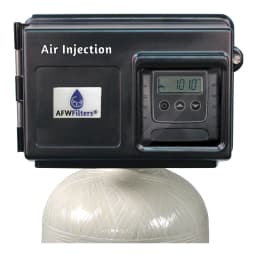
AFWFilters AIS10-25SXT
whole house
Top pick for problem well water. Air injection oxidizes iron (up to 10 ppm), manganese, and hydrogen sulfide (the rotten-egg smell) together — no chemicals, no cartridges to replace. The right tool when you have high iron and a sulfur odor.
$1399
no annual cartridges
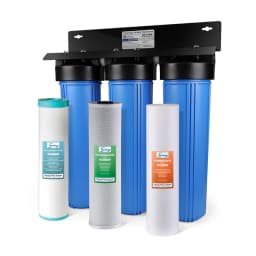
iSpring WGB32BM
whole house
Budget cartridge alternative for moderate iron (up to 3 ppm) and manganese plus sediment and chlorine. Much cheaper upfront than a tank system, but cartridges need replacing ~yearly and it won't fix a strong sulfur smell.
$470
$130/yr filters
Related: iron, manganese, hydrogen sulfide.
Cloudy, sandy or gritty water — sediment
Sand, silt, and grit from a well are handled by mechanical sediment filtration, sized to the right micron rating. Sediment filtration also goes first in any treatment train — it protects every stage downstream (softeners, iron filters, UV).
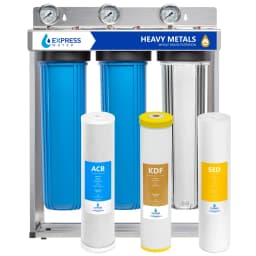
Express Water WH300SCKS
whole house
A 3-stage Big Blue system (sediment + carbon) that handles cloudy water plus taste and odor, using standard, widely available cartridges. A straightforward whole-house sediment + carbon setup for well or city water.
$548
$90/yr filters
iSpring WGB32BM
whole house
Doubles as a sediment system — its first stage is a 5-micron sediment filter — while also reducing iron and manganese. A good all-in-one if you have both cloudy water and moderate iron.
$470
$130/yr filters
Related: sediment & turbidity.
Bacteria & cysts — UV disinfection
If your well tests positive for coliform bacteria or E. coli — common in private wells — a UV systeminactivates them without chemicals. UV doesn’t remove iron, sediment, or minerals and needs clear water to work, so it’s installed after sediment (and any iron) filtration. Choose disinfection-grade NSF/ANSI 55 Class A.
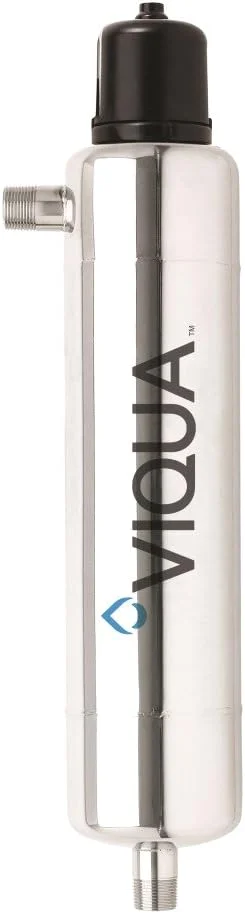
Viqua D4 Premium
uv
The long-time industry gold standard for UV disinfection, NSF/ANSI 55 certified. The D4 Premium itself is discontinued — its successor, the Viqua D4 Plus, sells through plumbing suppliers. For bacteria, insist on NSF 55 Class A certification for whichever specific model you buy, rather than an uncertified UV lamp.
$669
$164/yr filters
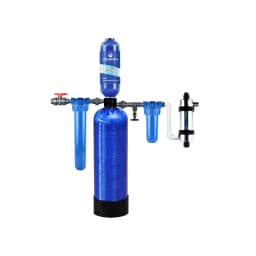
Aquasana Rhino Well Water with UV
whole house
The convenient all-in-one: 20-inch sediment pre-filter, carbon/KDF tank (500,000 gal / 5 yr) and UV in one kit with a 5-year warranty. Know the limits — its UV is certified to NSF/ANSI 55 Class B (supplemental disinfection), not Class A, and it does nothing for iron, manganese or hardness. Best for a well with clean test results where you want taste/odor polishing plus a UV safety net in one install.
$1749
$248/yr filters
Related: coliform bacteria, how UV systems work.
Taste & odor — whole-house carbon
If your well water is otherwise clean but tastes or smells off (or you treat it with chlorine), a whole-house catalytic-carbon system improves taste and odor at every tap. Carbon does not remove iron, hardness, or bacteria — pair it with the systems above if you have those problems too.
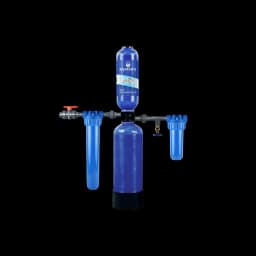
Aquasana Rhino WH-1000
whole house
A 10-year / 1,000,000-gallon whole-house carbon + KDF system, the premium pick for taste, odor, and chlorine across a whole home. Chlorine reduction is third-party tested to NSF/ANSI 42 (not certified); the tank is WQA-certified to NSF/ANSI 61 for materials safety. Rated 7 GPM — choose the Rhino Max Flow (14 GPM) for 3+ bathroom homes.
$999
$148/yr filters
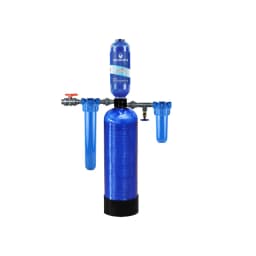
Aquasana Rhino Max Flow
whole house
Same 10-year media and 1,000,000-gallon rating as the Rhino at double the flow (14 GPM), so a large household doesn't lose shower pressure when the washer and a tap run together. Sold direct by Aquasana.
$1399
$148/yr filters
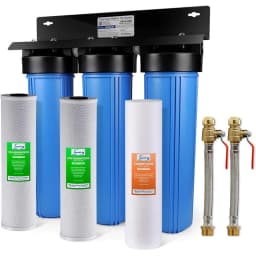
iSpring WGB32B
whole house
Budget 3-stage Big Blue (sediment + carbon block) that knocks down chlorine, taste, and odor using standard, widely available cartridges. The value option when you don't also need iron removal.
$350
$126/yr filters
Hard water & scale?
Scale on fixtures and spotty dishes is hardness, not a contaminant a filter removes — that needs a water softener (or a salt-free conditioner). Size one with our tool, and note that iron above ~1 ppm should be handled by an iron filter beforea softener so it doesn’t foul the resin.
Frequently Asked Questions
What is the best filter for well water?
There's no single best well-water filter, because well water is unregulated and every well is different. The right system depends on your test results: an air-injection oxidizing filter for iron and rotten-egg sulfur, a cartridge iron/manganese system for moderate iron, a sediment filter for cloudy water, a UV system for bacteria, and a carbon system for taste and odor. The first step is always a water test — then match the system to what you actually have.
Do I need to test my well water before buying a filter?
Yes. Private wells aren't covered by the Safe Drinking Water Act, so no one is testing your water but you. A certified lab test (for iron, manganese, hydrogen sulfide, hardness, pH, sediment/turbidity, and bacteria) tells you which contaminants you have and at what levels — which determines whether you need oxidation, a softener, UV, carbon, or a combination. Buying a filter before testing is the most common and most expensive well-water mistake.
What removes iron and the rotten-egg smell from well water?
An air-injection (oxidizing) filter is the standard fix for both, because it oxidizes dissolved iron and hydrogen sulfide so they can be filtered out — chemical-free and without cartridges to replace for years. For moderate iron without a sulfur smell, a cartridge-based iron/manganese system is a lower-cost option. A rotten-egg smell in hot water only usually points to the water heater's anode rod, not the well — see our hydrogen sulfide guide.
Will a water softener remove iron from well water?
A softener can remove low levels of dissolved (ferrous) iron along with hardness, but it isn't reliable for higher iron or for oxidized (rust-colored) iron, and it does nothing for a sulfur smell. For anything beyond low iron, an oxidizing iron filter is the right tool — and it's often paired with a softener rather than replaced by one. Test your iron level to know which you need.
Do I need a UV system for well water?
Only if your water tests positive for bacteria (such as coliform or E. coli), which is common in private wells. A UV system disinfects by inactivating microorganisms, but it doesn't remove iron, sediment, or chemicals, and it needs clear water to work — so it's installed after a sediment (and often iron) pre-filter. Look for NSF/ANSI 55 Class A certification for disinfection-grade UV.
Does a well-water filter need to be NSF certified?
NSF certification is reassuring but not universal for whole-house well systems — many oxidizing iron filters are assembled systems without a single NSF certification, while UV units are commonly NSF/ANSI 55 certified. Focus on matching the technology to your tested problem and verifying the manufacturer's performance claims; treat NSF certification as a plus, and be careful to distinguish 'NSF certified' from 'tested to NSF standards.'
Not sure what your well needs?
The Well Water Planner walks you from your test results to the right combination of systems.
Open the Well Water Planner →Informational guidance based on EPA data and NSF standards — not medical advice. Always test private well water before choosing treatment.