Manganese
Category: inorganic
Black or brown staining in your sinks and laundry, dark specks, and a bitter taste usually point to manganese — iron's frequent companion in well water. Most of the time it's a staining nuisance, but manganese has a genuine, if narrow, health dimension at higher levels, especially for bottle-fed infants. Here's how to read the numbers and remove it.
EPA MCL
Not regulated
Status
Unregulated
NSF Standard
NSF/ANSI 42 (aesthetic effects)
Health Effects
Manganese is unusual: it's an essential nutrient at low levels, a staining nuisance at moderate levels, and a potential health concern at high chronic exposure. The EPA's secondary (aesthetic) standard is 0.05 mg/L for black/brown staining and metallic taste. Separately, the EPA's non-enforceable health guidance sets a lifetime Health Advisory of 0.3 mg/L and a stricter short-term advisory of 1.0 mg/L aimed at protecting bottle-fed infants; the WHO's provisional health-based value is 0.08 mg/L. The health basis is possible neurological effects from long-term elevated intake, with formula-fed infants the most sensitive group.
Where It Comes From
Naturally occurring in soil and rock; it dissolves into groundwater much like iron, with which it almost always co-occurs. Manganese causes black, brown, or purplish staining of fixtures and laundry and a bitter metallic taste, and can form deposits in plumbing.
Where It's Commonly Found
Private wells and groundwater, very often alongside iron. More likely in deeper wells and low-oxygen aquifers.
A common companion to iron in well water. Private wells are not regulated under the Safe Drinking Water Act, so testing — especially with an infant in the home — is the owner's responsibility.
How to Remove It
Effective Technologies
- oxidation filtration
- ion exchange
- water softener
- reverse osmosis
Does NOT Remove It
- UV
- activated carbon
- mechanical filtration
The two thresholds that matter
Manganese has two separate kinds of guideline, and it helps to keep them straight. The EPA's Secondary Maximum Contaminant Level of 0.05 mg/L is aesthetic — the level at which black/brown staining and metallic taste become noticeable, and it is non-enforceable. Above that, the EPA's health guidance applies: a lifetime Health Advisory of 0.3 mg/L for ongoing exposure, and a stricter short-term advisory of 1.0 mg/L specifically intended to protect bottle-fed infants. The WHO lists a provisional health-based value of 0.08 mg/L.
So at typical staining levels (about 0.05-0.3 mg/L) manganese is mainly a nuisance; the health caution applies at higher chronic levels, and most acutely to infants. Manganese is also an essential dietary nutrient at low doses — the concern is excess, not its presence.
Why infant formula is the sensitive case
The reason the EPA sets a stricter short-term advisory is infants. Babies absorb more manganese and excrete it less efficiently than adults, and formula reconstituted with high-manganese well water can push intake above what their systems handle well. If you have an infant at home and a private well, test for manganese; if it's elevated, use a verified low-manganese or treated water source for formula until the supply is treated. This is conservative, standard guidance — not a claim that typical tap water harms babies.
How to remove manganese
Because manganese behaves like iron, the treatments overlap. For low levels of dissolved manganese, a cation-exchange water softener can remove it along with hardness and low iron. For higher levels, oxidation followed by filtration — manganese greensand, Katalox, birm, or air injection, sometimes with potassium permanganate (KMnO4) regeneration — is the standard whole-house approach; correct pH matters, because manganese oxidizes more slowly than iron. Reverse osmosis removes manganese at the point of use for drinking water.
Because iron and manganese almost always occur together, an oxidation-filtration system is usually sized for both at once. Test for total iron, manganese, pH, and hardness so the system matches your water, and verify any product's reduction claim against its NSF certification.
Testing and next steps
Use a certified lab to measure manganese (and iron, pH, and hardness) before buying equipment — the level determines whether a softener suffices or you need oxidation-filtration, and whether the infant advisory applies. The EPA recommends annual testing of private wells. Our well-water planner and whole-house sizing tool can help you scope a combined iron-and-manganese system once you know your numbers.
Frequently Asked Questions
Is manganese in well water dangerous?
At the low levels that cause staining (around the EPA's 0.05 mg/L aesthetic standard), manganese is mainly a nuisance, and it's actually an essential nutrient in small amounts. The health caution applies to higher chronic exposure — the EPA's lifetime Health Advisory is 0.3 mg/L — with bottle-fed infants the most sensitive group, which is why there's a stricter 1.0 mg/L short-term advisory. If levels are elevated and you have an infant, treat the water or use an alternate source for formula.
What causes black stains in my toilet or sink?
Black, brown, or purplish staining — and dark specks or slime — is the signature of manganese, usually alongside iron (which adds orange-red). Manganese deposits build up in toilets, sinks, tubs, dishwashers, and laundry. Treating the water stops new staining; existing stains respond to manganese/iron-specific cleaners rather than chlorine bleach.
What is a safe level of manganese in drinking water?
There's no single number, but the reference points are: the EPA aesthetic standard 0.05 mg/L (staining), the EPA lifetime Health Advisory 0.3 mg/L, a short-term advisory of 1.0 mg/L for infants, and the WHO provisional value 0.08 mg/L. Below about 0.05 mg/L it's generally a non-issue; above the health-advisory levels, treat it — and use treated or low-manganese water for infant formula.
Will a water softener remove manganese?
A cation-exchange softener can remove low levels of dissolved manganese along with hardness and low iron, but it isn't reliable for higher levels or oxidized manganese, which need oxidation plus filtration (greensand/Katalox, often with KMnO4). Since manganese usually comes with iron, many homes use a combined oxidation-filtration system rather than relying on a softener alone.
Cited Sources
- Secondary Drinking Water Standards: Guidance for Nuisance Chemicals — U.S. EPA
- Manganese (Drinking Water) — California State Water Resources Control Board
- Manganese in Drinking-Water (WHO background document, 2021) — World Health Organization
- Private Drinking Water Wells — U.S. EPA
Filters That Address Manganese
2 filters in our database list Manganese reduction.
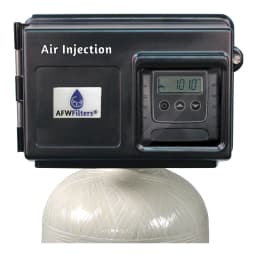
AFWFilters AIS10-25SXT
whole house
$1399
Price checked Sep 2026
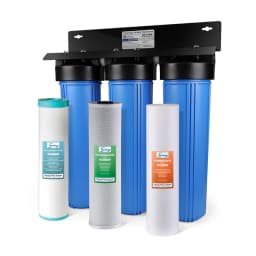
iSpring WGB32BM
whole house
$470
$130/yr filters
Price checked Jun 2026
Official Sources
Related Contaminants
Learn More
Check if Manganese is in your water
Enter your ZIP code to see local water quality data and get matched with the right filter.
Enter Your ZIP Code →Informational guidance based on EPA data and NSF standards - not medical advice.